


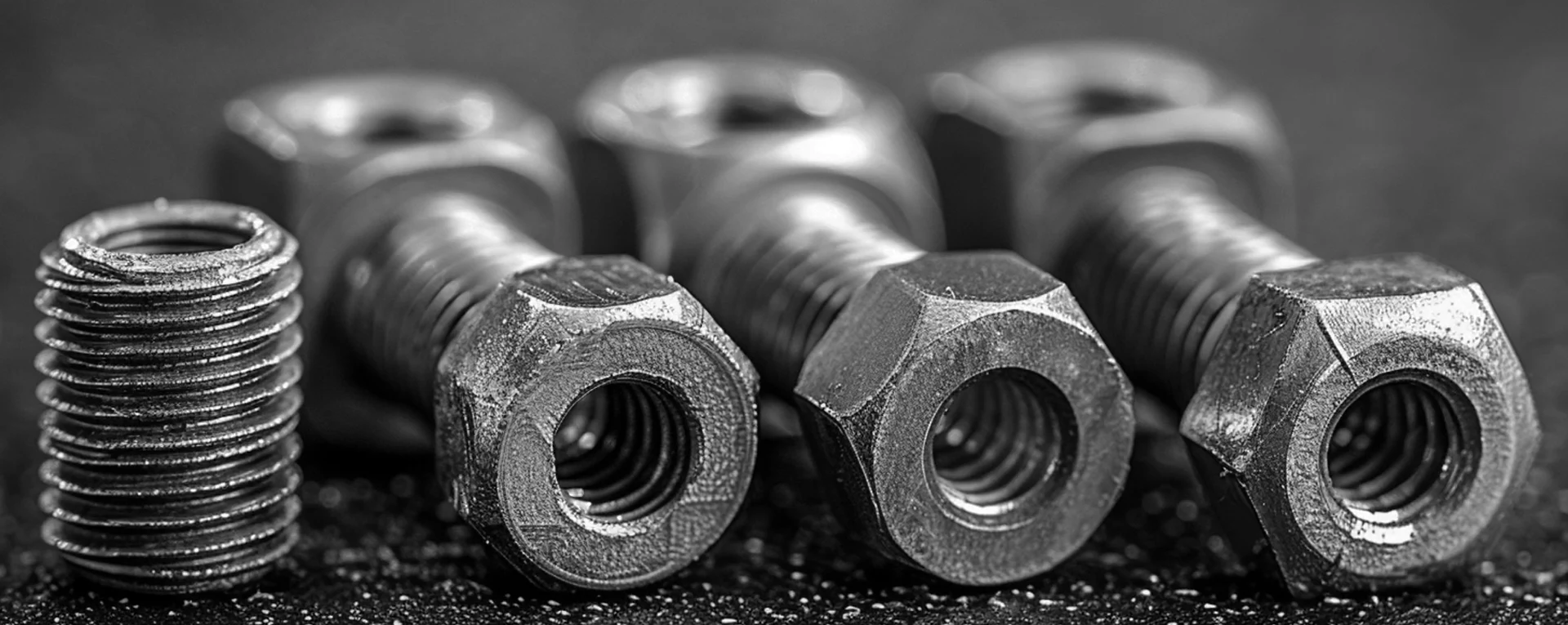
Aluminium turning is a key process in the manufacture of machined aluminium technical parts, intended for industrial environments where precision, weight and quality finish are decisive. Thanks to its excellent weight/strength ratio, good machinability and natural resistance to corrosion, aluminium is becoming a reference material for the production of precision aluminium parts in medium and large series.
Precision aluminum machining allows the manufacture of a wide variety of technical components: axes, spacers, bushings, inserts, end pieces or aluminum threaded parts, integrated into mechanical, electronic or technical systems.
Since 1946, Billardy has been supporting manufacturers in the manufacture of aluminum parts and precision aluminum bar turning, relying on its historical know-how in machining technical parts on drawings. Thanks to the mastery of CNC turning, micro-turning and machining operations, Billardy meets the needs of industrial companies looking for an aluminum parts manufacturer or a subcontractor in aluminum machining capable of producing reliable, precise and repeatable components.

Turning of aluminum parts: precision machining, technical constraints and industrial mastery
Turning aluminum parts requires perfect control of machining parameters to ensure dimensional compliance, production stability and the functional quality of manufactured parts.
While aluminum is recognized for its ease of machining and high productivity, its material behavior remains specific and requires a rigorous technical approach to secure the industrial process.
The manufacture of turned aluminum parts does not only consist in removing material. It involves mastering all the constraints related to the machinability of aluminum alloys, the geometry of the part, functional tolerances, surface conditions, and any rework or finishing operations.
The manufacture of precision machined aluminum parts thus requires perfect control over several parameters.
In an industrial logic, producing a machined aluminum part on plan is not only based on the ability to machine quickly, but also on the ability to guarantee a stable, repeatable and compliant manufacturing across all series produced.
CNC turning allows the manufacture of complex aluminum parts requiring a high level of precision, perfect repeatability and great dimensional stability in series production.
Aluminium CNC machining allows for more elaborate geometries, with great design freedom and perfect control of the functional areas. This technology is particularly suitable for the manufacture of technical aluminum parts incorporating several diameters, shoulders, drillings, threads or assembly areas.
Precision aluminum turning allows in particular to produce:
- machined aluminum pins,
- aluminum spacers,
- aluminum rings,
- aluminum sleeves,
- aluminum inserts,
- aluminum mouthpieces,
- threaded components,
- mechanical connection parts,
The mastery of the machining cycle, cutting speeds, material cutting and part holding results in excellent surface quality, high production consistency and tight tolerances, which are essential for technical industrial applications.
Aluminium micro-turning meets the needs for manufacturing small machined aluminium parts requiring very high dimensional precision and excellent production consistency.
The increasing miniaturization of many technical components requires today to produce very small parts while maintaining a high level of machining quality and functional conformity.
Aluminum micromachining allows in particular to manufacture:
- aluminum micro-axes,
- aluminum micro-rings,
- mini aluminum spacers,
- aluminum micro-inserts,
- aluminum micro-sockets,
- small connecting or centering parts,
On these parts, the stability of material support, cutting precision, and vibration control become particularly critical. The slightest deviation can directly impact dimensional compliance or the functionality of the part.
Le micro-décolletage de précision aluminium permet ainsi de répondre aux besoins des secteurs industriels où la miniaturisation, la précision et la répétabilité constituent des critères déterminants.
Some machined aluminum parts require additional operations after turning in order to fully meet the functional requirements of the specifications.
The recovery after aluminum machining allows to realize or finalize certain technical functions that cannot be integrated directly into the main cycle or that require an additional level of precision.
These finishing operations on aluminum parts concern:
- the aluminum tapping for assembly functions,
- the transverse drilling for bonding or fastening functions,
- counterboring for housing heads or functional areas,
- secondary milling for flat surfaces or specific shapes,
- the aluminum threads for clamping or connection functions,
These operations make it possible to optimize the functionality of the part, to secure its integration into the mechanical assembly, and to ensure its conformity in use.
In an industrial logic, the mastery of recovery operations is an essential lever to produce finished aluminum parts, ready for assembly, with a high level of quality, repeatability and technical performance.
Manufacturing of turned aluminum parts: which technical parts to machine?
Aluminum fasteners represent a significant part of the components manufactured in aluminum turning.
These parts provide assembly, bonding or mechanical support functions in many industrial systems where weight reduction and corrosion resistance are important criteria.
The manufacture of aluminum screws, aluminum inserts, aluminum spacers or aluminum bushings requires perfect control of functional tolerances, thread quality and surface finish to ensure their performance in use.
Among the main aluminum fastening parts manufactured in turned metal, we find in particular:
- aluminum screws for mechanical assembly or technical fixing,
- aluminum inserts for integration or assembly reinforcement,
- aluminum spacers for maintaining spacing or structural connection,
- aluminum bushings for guidance or functional protection,
The manufacture of these components requires a high dimensional regularity to ensure their reliability in assembly and their functional stability.
Machined aluminum shafts and mechanical connection components play a central role in many industrial mechanisms.
They provide functions of rotation, guidance, articulation or force transmission, while meeting the weight or corrosion constraints specific to certain technical applications.
The manufacture of aluminum shafts in turned parts makes it possible to produce:
- aluminum shoulder pins for axial support or mechanical positioning,
- aluminum pivots for articulation or rotation,
- aluminum pins for connection or guidance,
- aluminum guide pins for translation functions or functional maintenance,
These components require high dimensional precision, particularly on the functional diameters, spans or contact areas, in order to ensure their good mechanical behavior.
Turning aluminium spindle secures these requirements while ensuring repeatability and production stability.
Aluminium threaded parts are a wide family of technical components used in assembly, bonding or mechanical adaptation.
Here, threading is a critical function that requires precision, regularity, and dimensional conformity to ensure the assembly quality and mechanical strength of the whole.
The manufacture of threaded aluminum parts concerns:
- aluminum threaded bushings for assembly or guidance,
- aluminum threaded bits for connection or mechanical adaptation,
- machined aluminum adapters for bonding or mechanical processing functions,
- aluminum threaded spacers for support and attachment,
Aluminum tapping and the creation of precise threads require perfect control of cutting parameters in order to avoid profile defects, burrs or deformations in functional areas.
Turned parts thus make it possible to produce reliable, repeatable aluminium threaded components adapted to the constraints of industrial assembly.
In addition to fasteners or mechanical axes, precision turned aluminium machining makes it possible to manufacture numerous machined aluminium components directly integrated into industrial mechanisms or technical subassemblies.
These technical aluminum parts provide essential functions for guiding, centering, maintaining or positioning in environments where geometric precision is decisive.
Among the main components manufactured are:
- aluminum pins for locking or centering,
- machined aluminum rings for mechanical guidance or protection,
aluminum guides for functional support, - machined aluminum supports for technical integration or attachment,
These components can include drillings, grooves, countersinks, shoulders or functional surfaces requiring perfect control of the manufacturing process.
The turning of technical aluminium components thus makes it possible to produce custom-made parts with a high level of precision, stability and industrial repeatability.
Aluminium bar turning makes it possible to manufacture a wide variety of technical aluminium parts intended for assembly, fastening, guiding or mechanical integration in many industrial environments.
Thanks to its good machinability, its lightness and its ability to be worked with precision, aluminum is particularly suitable for the manufacture of machined aluminum parts on plan, whether they are standard components or technical parts with specific geometry.
The production of aluminium turned parts includes fasteners, mechanical shafts, threaded components or connecting parts as well as functional components for guiding, centring or technical assembly functions.
The choice of precision aluminum bar turning directly depends on the function of the part, its level of geometric complexity, expected tolerances and integration constraints in the mechanical assembly.
At Billardy, the manufacturing of machined aluminum parts is based on an industrial approach focused on precision, repeatability and process optimization, in order to adapt each production to the real technical constraints of the part.
Which aluminium alloys should be chosen for the turning and machining of technical parts?
The choice of aluminum alloy is a decisive step in the manufacture of turned aluminum parts. In precision bar turning, not all grades of aluminum exhibit the same machining behavior, the same mechanical performance or the same finishing capabilities.
Choosing the right alloy does not only depend on machining feasibility. It directly impacts the dimensional stability of the part, cutting quality, surface finish, mechanical strength, corrosion resistance, and compatibility with surface treatments such as anodizing.
In the manufacture of machined aluminum parts, the material must always be selected according to the actual function of the part, its environment of use and its mechanical or aesthetic constraints.
Some aluminum alloys offer excellent machinability and allow the production of turned aluminum parts with high precision, while others favor mechanical strength, structural integrity or finish quality.
The 2017 and 2024 aluminum alloys are among the most efficient grades for precision aluminum turning when a good level of mechanical strength is required.
The 2017 aluminum machining is particularly appreciated for its very good machinability, cutting stability and ability to produce technical parts with tight tolerances and good surface finishes.
This alloy is frequently used to manufacture:
- aluminum axes,
- technical rings,
- spacers,
- threaded components,
- mechanical connection parts,
The 2024 aluminum machining has superior mechanical strength, particularly suitable for applications subject to greater mechanical stress.
Machining of aluminum 6060 and 6061: versatile aluminum alloys for anodising and technical finishing
Aluminum alloys 6060 and 6061 are widely used in the manufacture of machined aluminum parts due to their versatility and good compatibility with surface treatments.
This alloy is particularly suitable for making:
- aluminium mounting part,
- technical support,
- threaded tip
- linking coponents
- anodized mechanical parts,
The 6061 aluminum anodisation improves surface protection, wear resistance and aesthetic appearance of the part, while maintaining good dimensional stability.
Aluminium 6060, more oriented in terms of finish and aesthetics, remains particularly relevant when the surface quality and final appearance are priority criteria.
These shades are often preferred in sectors where the combination of lightness, anti-corrosion protection and technical finish is sought.
Aluminium 6082 is particularly sought after for the manufacture of technical aluminium parts requiring higher mechanical strength while retaining the structural advantages of aluminium.
Machining 6082 aluminum allows the production of technical components subject to significant mechanical stress or reinforced structural constraints.
Turning 6082 aluminum is a particularly relevant solution when the mechanical function of the part imposes a higher resistance than more conventional grades.
The choice of the right aluminum alloy for machining directly depends on the technical function of the part and its operating environment.
If the main objective is to focus on machinability and manufacturing precision, grades such as aluminum 2017 or 6061 offer excellent results in bar turning.
When the priority is mechanical strength or structural integrity, alloys such as 2024 or 6082 become more suitable.
If the part needs to be treated with a surface treatment or anodizing, some grades such as 6060 or 6061 offer better compatibility and finish quality.
Manufacture of turned aluminum parts: applications by industrial sector
The aeronautical sector is one of the main areas of application for aluminium bar turning.
In aeronautics, every gram counts. Weight reduction is a direct driver of energy performance, autonomy and structural optimization.
It is precisely for this reason that aluminum remains a strategic material in the manufacture of many technical components used in aeronautical systems.
Turning aluminum parts for aeronautics allows in particular to produce:
- technical areas,
- guide rings,
- structural spacers,
- mechanical inserts,
- des composant fileté,
- connection tips,
The choice of aluminum alloy, mastery of the machining process and manufacturing repeatability are crucial here to ensure the conformity of parts and their integration into aeronautical systems.
Aluminum turning for the automotive industry: technical components, lightening and series production
The automotive industry is also a major sector for the manufacture of machined aluminum parts.
In the world of automotive engineering, weight reduction has become a central issue to improve energy performance, reduce emissions and optimize vehicle range, especially on electrified platforms.
Aluminium bar turning for the automotive industry allows to produce a wide variety of technical components intended for mechanical, structural or assembly functions.
The manufacture of aluminum parts for the automotive industry thus requires strong industrial control to ensure production stability, dimensional compliance and high productivity.
Precision aluminum bar turning meets these requirements while maintaining the structural and economic advantages of aluminum.
The development of drone systems, whether civil, industrial or technical, generates growing needs for precision machined aluminum parts capable of meeting high weight, mechanical reliability and compactness requirements.
In the world of drones, each onboard gram directly influences range, flight stability, energy consumption and carrying capacity.
Aluminium is therefore a particularly suitable material for the manufacture of mechanical components for drones, thanks to its excellent weight/strength ratio, good machinability and natural resistance to corrosion.
Industrial electronic equipment incorporates many machined aluminum parts intended to provide essential mechanical functions: fastening, holding, guiding, heat dissipation or subassembly integration.
In these applications, the choice of aluminum addresses several technical issues: weight reduction, good thermal conductivity, corrosion resistance and ease of machining on precise geometries.
Aluminium bar turning for electronic equipment enables the manufacture of small or medium-sized technical components with a high requirement for precision and consistency.
The turning of aluminum parts for electronics makes it possible to produce technical components combining mechanical precision, functional integration and industrial optimization, in sectors where reliability and miniaturization are becoming increasingly strategic.
Turned aluminum parts are used in many industrial sectors where weight reduction, dimensional accuracy, corrosion resistance and functional stability are major criteria.
Thanks to its mechanical properties and its ability to be machined with precision, aluminum is essential in the manufacture of machined technical parts, fastening components, shafts, threaded parts or connection components integrated into demanding industrial systems.
Precision turned aluminium machining enables the production of technical off-plan components with high repeatability, tight tolerances and excellent surface quality, while meeting the specific requirements of each industry.
At Billardy, the manufacture of machined aluminum parts allows us to support various industrial sectors with a constant logic of performance, reliability, and industrial optimization.
Billardy: manufacturer of aluminum parts for bar turning and precision machining since 1946
Since 1946, Billardy has been supporting manufacturers in the manufacture of precision machined aluminum parts, relying on its historical expertise in bar turning and machining technical parts on drawings.
The manufacture of aluminum parts requires perfect control of material behavior, cutting parameters and functional constraints specific to aluminum alloys.
Lighter than steel, more thermally conductive and particularly suitable for many technical applications, aluminum requires a specific approach to ensure dimensional accuracy, surface quality and production stability.
Thanks to its historical know-how in precision bar turning and the manufacture of technical aluminium parts, Billardy supports manufacturers looking for a reliable partner to produce machined aluminium components with high technical requirements.
The manufacture of aluminum parts on request is based on a perfect mastery of the entire industrial chain, from the analysis of needs to series production. Each technical part meets precise specifications incorporating dimensional, functional, material and sometimes aesthetic requirements, which must be taken into account from the industrialization phase.
Manufacturing an aluminum part machined on plan is not only about reproducing a geometry. It is a question of understanding the real function of the part in its mechanical environment in order to optimize its manufacture, production cost and reliability.
At Billardy, the study of each project of aluminum turning on plan includes several key parameters.
This approach makes it possible to anticipate manufacturing constraints and direct the process towards the most relevant solution: CNC turning, micro-turned aluminum machining, rework operations or technical finishes.
The production of aluminum parts in medium and large series requires an industrial organization able to guarantee precision, stability and repeatability on all manufactured volumes.
In serial aluminum bar turning, performance is not only measured by the ability to produce quickly, but also by the ability to produce accurately, consistently and sustainably.
Each manufactured part must maintain the same level of dimensional conformity, surface quality and functional characteristics from the first to the last product component.
Are you looking for an aluminum parts manufacturer, a subcontractor in aluminum turning or a partner capable of producing your technical aluminum parts on average or large series?
Billardy supports you in the study, industrialization and manufacture of your precision aluminum parts, adapting the manufacturing process to your technical, functional and economic constraints.